

I've spent a lot of time experimenting with futures trading strategies, but this week I decided to start properly documenting one of my biggest experiments yet: building and testing my own automated futures trading bot.
Instead of trying to predict which hours would perform best, restricting the strategy to the New York session, or constantly changing settings to produce the perfect backtest, I wanted to see what would happen if I simply let the strategy trade.
So that's what I did.
From September 14 to September 18, 2026, I ran my automated strategy on MNQ (Micro E-mini Nasdaq-100 futures) using a simulated paper-trading account.
The strategy was allowed to trade approximately 23 hours per day, taking both long and short trades.
For this particular test, I used:
- Instrument: MNQ
- Position size: 2 micro contracts
- Initial stop: 150 ticks
- Trading direction: Long and short
- Trading hours: Approximately 23 hours per day
- Account: Simulation/paper trading
- Test period: September 14–18, 2026
By the end of the test, the strategy had generated a net simulated profit of $2,019.50.
Before going any further, there is an important distinction to make:
This was simulated trading. It was not $2,019.50 of real trading profit.
It's also only five trading days of data. A profitable week certainly doesn't prove that I've created a profitable trading system.
What it does give me is a starting point.
And that's exactly what I'm going to document on this blog.
Why I'm Building an Automated Futures Trading Bot
One thing I've increasingly questioned with my own trading is the obsession with capturing tiny market movements.
Small stop. Small target. Get in. Get out. Repeat.
It sounds great in theory, particularly when looking at strategies with high win rates.
But Nasdaq can move hundreds of points when it gets going.
The more I've worked on this strategy, the more interested I've become in doing almost the opposite:
Give trades room to develop, control the downside once the trade starts working, and try to capture the occasional large move.
This version of my automated futures trading bot therefore uses a relatively wide initial stop.
My default stop during this test was 150 ticks on MNQ, equivalent to 37.5 Nasdaq points.
With two MNQ contracts, that represents approximately $150 of initial risk if the full stop is taken.
But the initial stop is only one part of the system.
The Biggest Change I've Made to the Strategy
One of the most important changes I've recently made has been how the strategy manages trades after entry.
Previously, I experimented with managing the trailing stop based on completed bars.
There was a problem.
A two-minute Nasdaq candle can move significantly in your favour and then retrace before the candle ever closes.
Imagine the strategy enters a long position and price suddenly moves sharply higher.
For a few seconds, the position might be substantially profitable.
Price then reverses just as quickly.
If the strategy waits for the two-minute candle to close before making a decision, much of that favourable movement could disappear before the strategy reacts.
So I changed the strategy to manage its trailing stop using tick-by-tick market data.
The strategy can therefore react to favourable price movement while the candle is still forming.
This is one of the aspects of automated trading that interests me most.
A computer doesn't need to see the candle close, process what happened and manually move a stop. It can evaluate its programmed conditions as market data arrives and respond when those conditions are satisfied.
The objective isn't necessarily to predict the market better.
It's to manage the trade differently once I'm already in it.
My Automated Futures Trading Bot Results
Between September 14 and September 18, the strategy completed 46 trades.
The overall simulated results were:
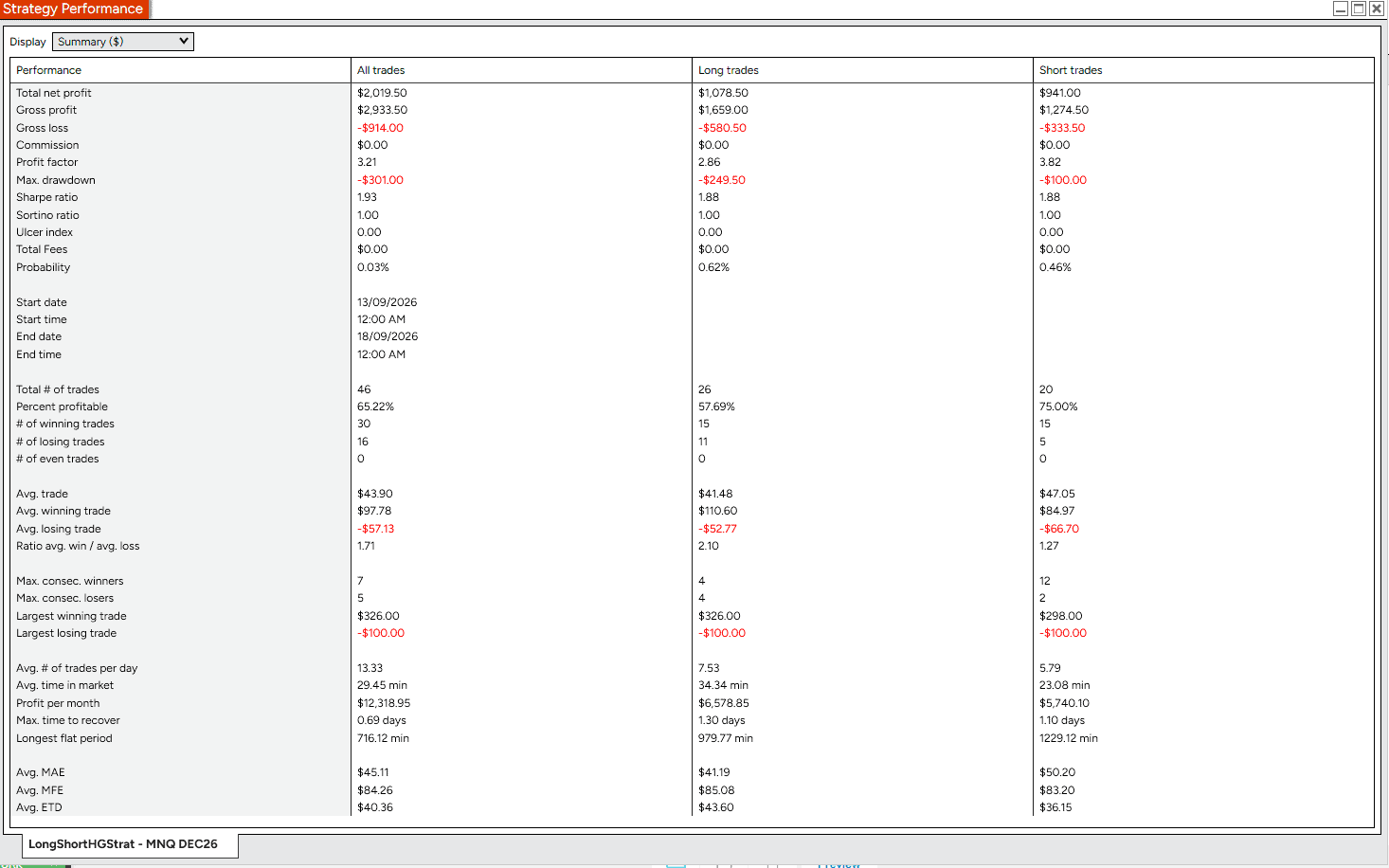
| Metric | Result |
|---|---|
| Net profit | +$2,019.50 |
| Total trades | 46 |
| Winning trades | 30 |
| Losing trades | 16 |
| Win rate | 65.22% |
| Average trade | +$43.90 |
| Average winner | +$97.78 |
| Average loser | -$57.13 |
| Largest winner | +$326.00 |
| Largest loser | -$100.00 |
| Profit factor | 3.21 |
| Maximum drawdown | -$301.00 |
One of the things I like most about these initial results isn't simply the 65% win rate.
The average winning trade was $97.78, compared with an average losing trade of $57.13.
That's an average win-to-average-loss ratio of approximately 1.71.
I'm not particularly interested in developing a strategy that relies on winning almost every trade. Losses are unavoidable.
What interests me more is whether the strategy can keep losses under control while allowing successful trades enough room to become meaningful winners.
Five Profitable Days — But Not Five Easy Days
The daily results were also interesting.
| Date | Simulated Net Profit |
|---|---|
| September 14 | +$371.50 |
| September 15 | +$723.50 |
| September 16 | +$422.00 |
| September 17 | +$112.50 |
| September 18 | +$390.00 |
| Total | +$2,019.50 |
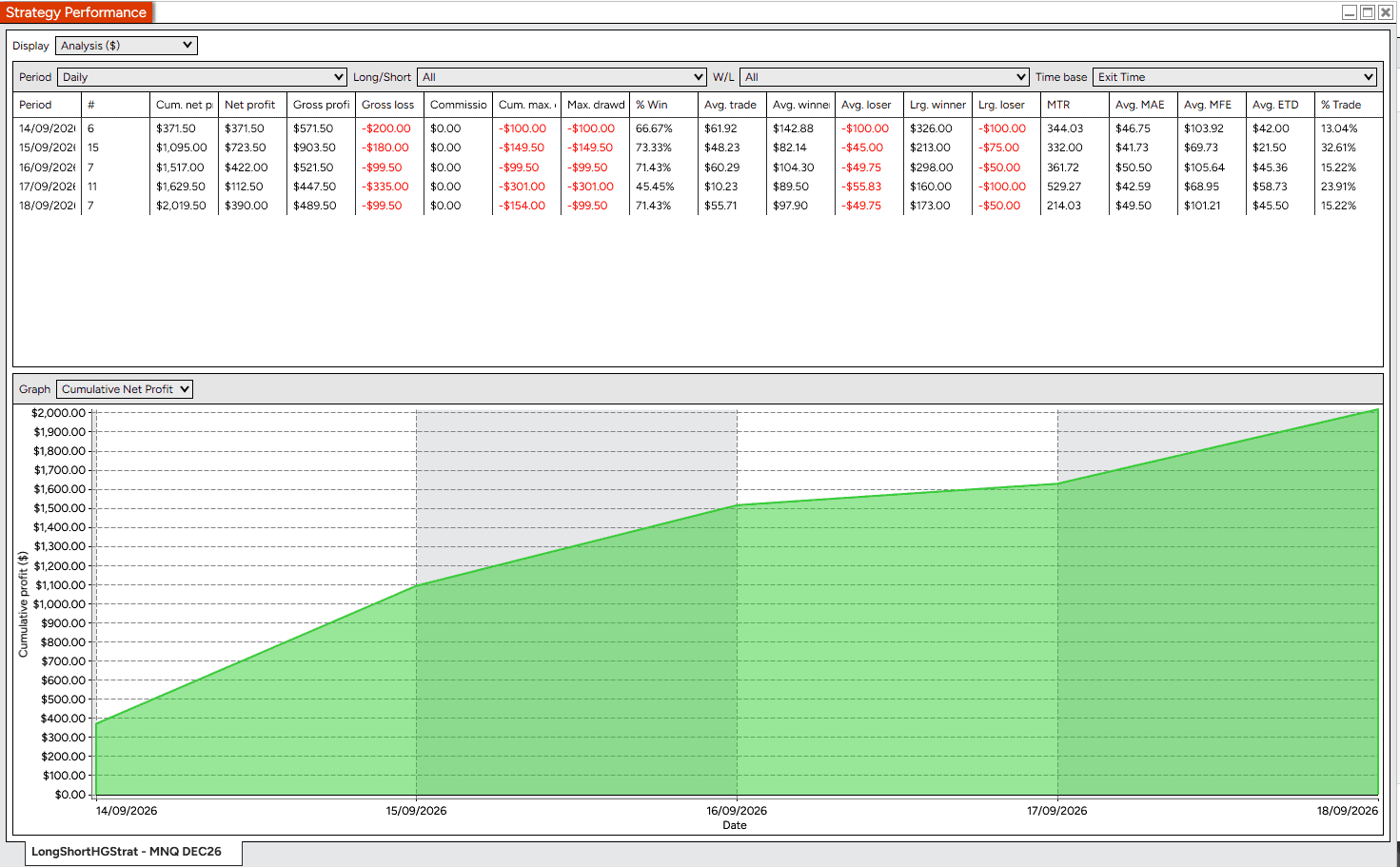
Every day finished profitable during this particular test.
However, that doesn't mean the strategy simply moved upward in a straight line.
September 17 is a good example.
The strategy ultimately finished the day +$112.50, but experienced approximately $301 of maximum drawdown during the session.
There were also five consecutive losing trades during the overall test.
Those numbers matter.
A screenshot showing +$2,019 at the end of the week makes automated trading look easy. The trades occurring underneath that equity curve tell a much more complicated story.
What Happened When I Let It Trade 23 Hours?
Another deliberate decision was allowing the strategy to operate for approximately 23 hours per day.
I could have tested dozens of different trading windows, found the hours that produced the highest historical profit and only shown those results.
I didn't want to start there.
Instead, I wanted the strategy exposed to different market conditions throughout almost the entire futures trading day.
Some hours performed extremely well.
Others lost money.
For example, this week's results showed strong performance during several overnight and morning periods, while other periods produced net losses.
But with only 46 total trades, there simply isn't enough information for me to conclude that one particular hour is inherently better than another.
As I accumulate more trades, this is something I'll continue monitoring.
What Happens Next?
This is where the experiment becomes more interesting.
I'm not planning to look at a $2,019 simulated week and immediately increase my position size.
I'm actually doing the opposite.
The next stage I'm considering is running the strategy using only 2 MNQ contract on a $25,000 prop-firm evaluation account.
At one MNQ contract, a 150-tick initial stop represents approximately $75 of initial risk before trading costs.
That gives the strategy significantly more room to experience losing trades and drawdown without taking excessive risk on an evaluation.
More importantly, it gives me a completely different test.
Can the strategy survive outside SIM?
Can it stay within a prop firm's drawdown rules?
How will the tick-based trade management behave with live order execution?
Can it pass an evaluation?
And if it eventually reaches a funded account, could it produce an actual payout?
I don't know yet.
That's the reason I'm documenting the experiment rather than presenting the strategy as a finished product.
There will almost certainly be losing periods, modifications and possibly failed evaluations along the way.
I'll document those as well.
For now, Week 1 produced +$2,019.50 in simulated trading from 46 trades using two MNQ contracts.
It's an encouraging beginning.
But five days is nowhere near enough data to determine whether I've actually built a robust automated futures trading system.
Now I need to find out.
Frequently Asked Questions About Automated Futures Trading
What is an automated futures trading bot?
An automated futures trading bot is software programmed to identify trading conditions and perform some or all of the trading process automatically.
Depending on how it is designed, the software may identify entries, submit orders, place stops and profit targets, adjust trailing stops and close positions without requiring the trader to manually manage each action.
My strategy is being developed for futures markets and includes automated entry and trade-management rules.
What futures prop firms allow automated trading?
The rules vary significantly between futures prop firms and can change over time.
Some firms permit automated strategies or trading software but place restrictions on particular practices, account types, copy trading or other forms of automation. Anyone considering running a trading bot through a prop firm should check that firm's current terms and trading rules before purchasing an evaluation or deploying a strategy.
I'll also be documenting the prop-firm side of my experiment as I progress from simulated testing toward evaluation accounts.
Are automated futures trading strategies profitable?
They can be profitable, but automation itself doesn't make a strategy profitable.
A computer can execute an unprofitable strategy just as efficiently as it can execute a profitable one.
An automated strategy still needs sensible entry logic, risk management and trade management, and historical results don't guarantee that the same behaviour will continue in future market conditions.
That's one reason I'm publishing these results over time rather than drawing conclusions from one profitable week.
Is futures trading profitable?
Futures trading can produce profits, but it also involves substantial risk and losses can occur quickly because futures are leveraged products.
Profitability depends on factors including the trading strategy, execution, transaction costs, position sizing and risk management.
My goal with this experiment isn't to demonstrate that futures trading is automatically profitable. It's to document what actually happens when I take a strategy from simulation through increasingly realistic trading conditions.
Can you automate futures trading?
Yes. Futures trading strategies can be automated using trading platforms and software capable of programmatically submitting and managing orders.
The amount of automation can vary considerably. Some traders automate only entries or trade management, while others develop systems capable of handling the entire trade from entry through exit.
My current experiment is focused on developing an automated futures trading bot that can identify trades and manage them programmatically, allowing me to test its performance without manually managing every market movement.
0 comments